
What Is Functional Blood Chemistry?
 Have you ever wondered what you can do instead of pharmaceutical drugs to address out of range lab numbers on your blood test? To find out the answer to this very important life enhancing question consider looking into Functional Blood Chemistry analysis. Functional Blood Chemistry analysis uses the same blood lab testing as western medicine, however, in Functional Blood Chemistry, we like to look at many more markers including 9 markers for thyroid function and a full iron panel on every patient.
LabCorp’s OptiThyroPlex II Components
Metabolic and Organ Function
Comprehensive Metabolic Panel (CMP14)
Glucose
Blood Urea Nitrogen (BUN)
Creatinine
BUN/Creatinine Ratio
Estimated Glomerular Filtration Rate (eGFR)
Sodium
Potassium
Chloride
Carbon Dioxide, Total (CO2)
Protein, Total
Albumin
Globulin, Total
Albumin/Globulin Ratio (A/G Ratio)
Calcium
Alkaline Phosphatase
Aspartate Aminotransferase (AST/SGOT)
Alanine Aminotransferase (ALT/SGPT)
Bilirubin, Total
Additional Metabolic Tests
Hemoglobin A1c (HbA1c)
Uric Acid, Serum
Phosphorus, Serum
Magnesium, Serum
Lactate Dehydrogenase (LDH)
Gamma-Glutamyl Transferase (GGT)
Iron Status and Transport
Iron, Serum
Ferritin
Iron Binding Capacity (TIBC) with % Saturation
Total Iron Binding Capacity (TIBC)
Unsaturated Iron Binding Capacity (UIBC)
Iron Saturation (%)
Cardiometabolic Risk
Lipid Panel with LDL/HDL Ratio
Total Cholesterol
Triglycerides
HDL Cholesterol
VLDL Cholesterol
LDL Cholesterol
LDL/HDL Ratio
Total Cholesterol/HDL Ratio
Additional Cardiometabolic Markers
C-Reactive Protein, Cardiac (High-Sensitivity CRP)
Homocysteine, Total
Thyroid Function and Autoimmunity
Thyroid Panel with Thyroid-Stimulating Hormone (TSH)
Thyroid-Stimulating Hormone (TSH)
Thyroxine, Total (T4)
T3 Uptake
Free Thyroxine Index (FTI)
Triiodothyronine (T3), Total
Triiodothyronine, Free (T3, Free)
Thyroxine, Free (T4, Free), Direct, Serum
Thyroid Peroxidase (TPO) Antibodies
Thyroglobulin Antibodies (TgAb/TGA)
Other Metabolic and Hematology
Vitamin D, 25-Hydroxy
Methylmalonic Acid, Serum
Fibrinogen Activity
CBC with Differential and Platelets
Complete Blood Count (CBC) with Differential and Platelet Count
White Blood Cell Count (WBC)
Red Blood Cell Count (RBC)
Hemoglobin
Hematocrit
Mean Corpuscular Volume (MCV)
Mean Corpuscular Hemoglobin (MCH)
Mean Corpuscular Hemoglobin Concentration (MCHC)
Red Cell Distribution Width (RDW)
Platelet Measurement
– Platelet Count
White Blood Cell Differential – Percentages
Neutrophils (%)
Lymphocytes (%)
Monocytes (%)
Eosinophils (%)
Basophils (%)
Absolute White Blood Cell Differential
Neutrophils (Absolute)
Lymphocytes (Absolute)
Monocytes (Absolute)
Eosinophils (Absolute)
Basophils (Absolute)
Immature White Blood Cell Measurements
Immature Granulocytes (%)
Immature Granulocytes (Absolute)
The reason we want to see a full blood chemistry profile as listed above along with a routine urinalysis is that we want to look for out of range markers that show a body is tending towards a diseased state, not just be concerned when the blood markers already show a disease in process. Functional Blood Chemistry analysis is prevention medicine. You see, the “Optimal Ranges” that we use in Functional Blood Chemistry analysis are based on true health, as found with empirical research and historical evidence. In comparison, conventional blood test “Lab Ranges” utilize blood range results based on the average health of a sampled population, healthy or not. The conventional lab ranges change over time as the health of the population changes, for better or worse. Optimal ranges remain the same as they are based on a natural standard of human health. To help you understand how this looks in practical application, take a good look at the sample of our Functional Blood Chemistry analysis below, within the 12-page document are the results of two sample patients. The “Patient Blood Panel Results” has 3 columns–Value, Optimal Range, and Lab Range. 1. VALUE: Is referring to the patient’s lab results. If the VALUE has yellow highlight, the lab marker is out of OPTIMAL RANGE; if the value has red highlight, the patient lab marker is out of LAB RANGE. 2. OPTIMAL RANGE: This range is based on natural Functional Blood Chemistry parameters. This range stays stable overtime and is based on the expression of a healthy person. 3. LAB RANGE: This range is based on current conventional Western Medicine parameters. This range changes overtime based on the health of the population at the time the range was determined. Following each Patient Lab Results, you will see a supplement schedule chart using nutrient rich food based supplements from Standard Process and highest quality Western Herbal Medicine supplements from MediHerb as support for the body to restore function.
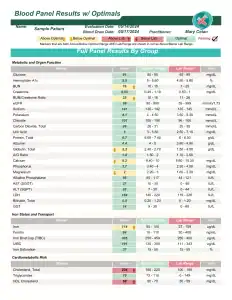
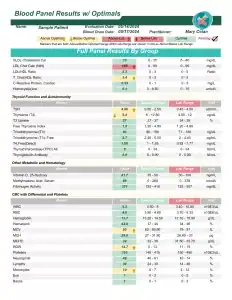
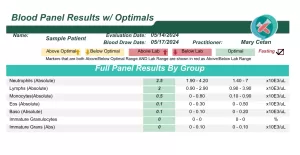
 To help you understand what can be learned about the workings of the body through blood lab chemistry testing, read the document below from Professional Co-op..
If you would like to work with Nature’s Wisdom Healing Center-Mary Cetan, for your lab work & Functional Blood Chemistry analysis reach out on form below. If you are new to the clinic, you can receive a LabCorp blood lab requisition at your Initial Visit. If you are a current patient, you can pick up the LabCorp requisition or we can send it to you via email. Please let us know how to help you in comment section below.

